
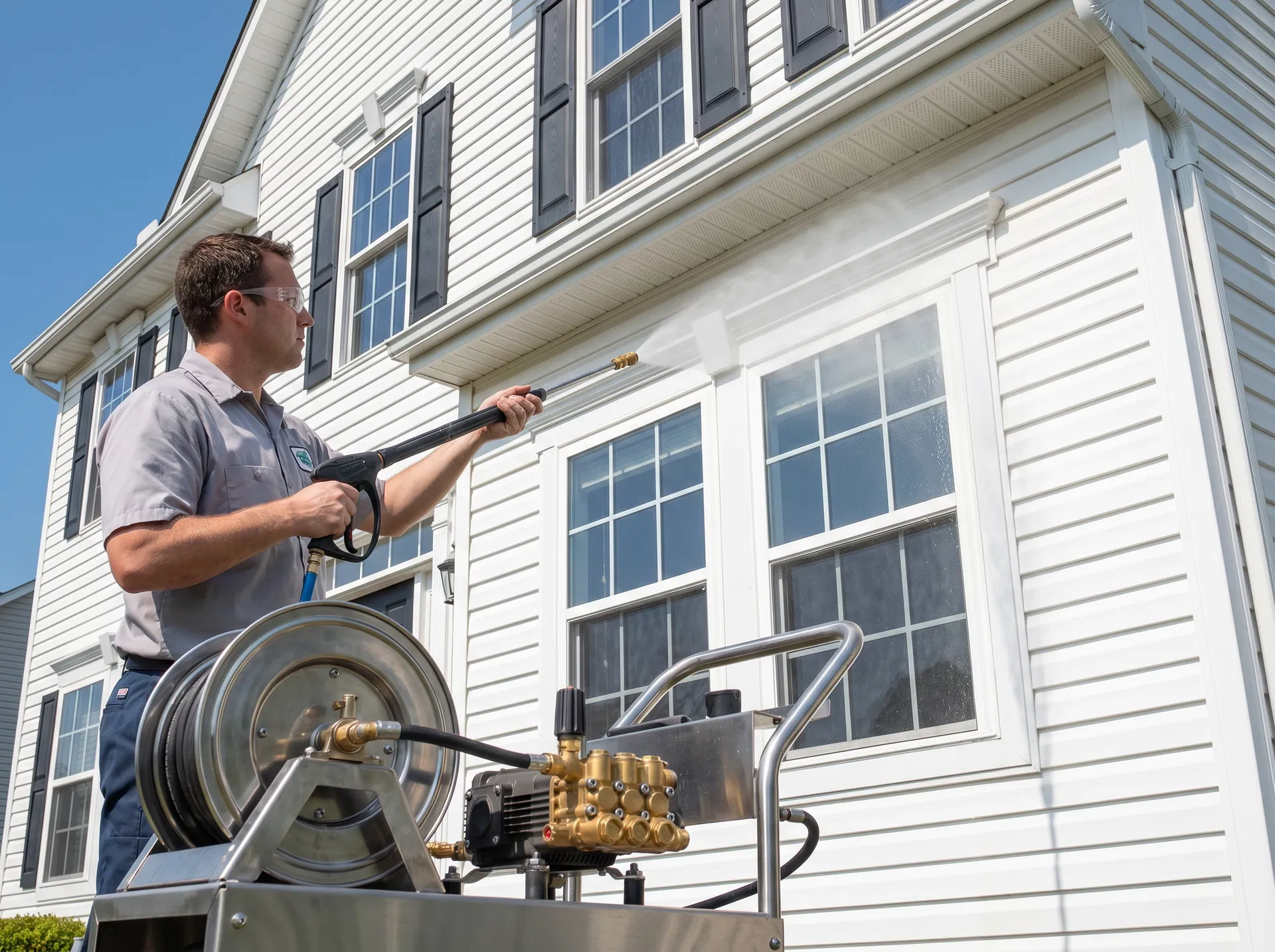
The green and black streaks on your siding are not dirt. They are living growth, mostly algae and mildew, and the Hampton Roads climate hands them everything they need: humid air coming off the water, more than 45 inches of rain in a typical year, mild winters that never kill them off, and a pollen season that works like a food delivery. The only way to remove them for more than a season is to kill the growth at its source with a low-pressure soft wash instead of blasting the stains off the surface.
We wash houses across Chesapeake, Virginia Beach, and Suffolk, and we see the same pattern on almost every street. The north side of the house goes green first. The shaded wall under the oaks follows. The neighbor with full sun stays clean a year longer and wonders what you are doing wrong. You are not doing anything wrong. This is just what our climate does to siding, and here is why.
What Are the Green Streaks on My Siding?
That green film is algae. The spores are airborne, they land on every house in the region, and they take hold wherever they find two things: moisture and food.
Moisture is the easy part around here. Any wall that stays damp into the afternoon is a candidate, which is why growth almost always starts on north-facing siding, walls shaded by trees, the strip hidden behind your shrubs, and anywhere a sprinkler head oversprays the house.
Food is the part most homeowners never think about. Dust and organic debris feed algae, but the biggest contributor in Hampton Roads is pollen. Every spring the loblolly pines coat the region in a yellow-green film, and whatever the rain does not rinse off sits on your siding as a buffet. It is a big reason houses here green up faster than the same vinyl would in a drier part of the country.
What About the Black and Gray Stains?
Most dark gray or black staining on siding is mildew, which is a mold. It likes the same damp, shaded conditions as algae and usually shows up right alongside it, especially under soffits, around window trim, and on the shady side of dormers.
Two other black stains are worth telling apart, because they are different problems:
- Tiny black specks near mulch beds that look like tar dots are usually artillery fungus. It lives in wood mulch and fires sticky spores up to 20 feet onto siding, cars, and fences. Honest answer: once those spores cure, nobody can remove them completely, us included. Anyone who promises otherwise has not dealt with it. The real fix is prevention. Keep wood mulch away from the house, or switch to stone or pine straw against the foundation.
- Black streaks running down the face of your gutters, sometimes called tiger striping, are not growth at all. That is oxidized finish and bonded road film, and it takes a different cleaner than algae does. If you have it, point it out when you ask for a quote so it gets treated the right way.
Why Does It Grow So Fast in Hampton Roads?
Look at a map. Chesapeake, Virginia Beach, and Suffolk sit surrounded by water: the Chesapeake Bay to the north, the Atlantic at Sandbridge, the Elizabeth and Nansemond rivers cutting through the middle, the Intracoastal Waterway running past Great Bridge, and the Great Dismal Swamp parked along Deep Creek and southern Suffolk. All that water keeps humidity high most of the year, and humid air means siding that stays damp long after the morning dew burns off everywhere else.
Then add the rest of it:
- More than 45 inches of rain in a typical year.
- Mild winters. In colder states, hard freezes knock algae and mildew back every season. Ours usually do not, so the growth barely pauses and gets a head start every spring.
- Heavy tree cover in established neighborhoods. Mature oaks and pines in areas like Great Bridge, Kempsville, and Western Branch mean shade, drip, and a steady supply of organic debris on the walls below.
- Salt air near the beach and the rivers, which holds moisture on surfaces and helps grime stick.
Put it all together and this region is close to ideal growing conditions for the stuff staining your house. Generic advice online says you can go two or three years between washes. Around here, most homes need a wash every 12 to 18 months, and heavily shaded or north-facing homes often need one every year.
Is It Hurting the Siding, or Just Ugly?
Honest answer: for the first year or so, it is mostly a curb appeal problem. But growth left on a surface does real work over time.
Algae and mildew hold moisture against whatever they grow on. On vinyl, growth that bakes on through enough summers can leave shadowing that cleaning will not fully reverse. On painted trim and wood siding, that trapped moisture breaks down paint and caulk years ahead of schedule. On wood fences and decks, it feeds the slow rot that turns a cleaning problem into a lumber problem, which is exactly what our fence cleaning service is meant to head off. And on concrete, steps, and pool decks, that same growth is the slick green film people slip on.
There is a practical side too. If you live in an HOA neighborhood, streaked siding is one of the most common violation letters we hear about. And if you are selling, a green north wall is the first thing a buyer sees from the driveway.
Why Does It Come Back a Few Months After Pressure Washing?
Because high pressure removes the stain, not the organism. Blasting siding strips off the visible layer of algae, but spores stay behind in the texture of the surface, and the growth is usually visible again within months. High pressure on siding also carries risks that have nothing to do with algae. It can force water behind panels, into soffits, and around window trim, causing the exact moisture problems you were trying to avoid. It is why siding manufacturers warn against high pressure in their care guides.
Soft washing works differently. We apply a professional cleaning solution at low pressure, about the force of a garden hose, let it kill the algae and mildew at the root, and rinse. The results last several times longer than pressure alone because there is nothing left alive to regrow. We broke down the full comparison in our guide to soft washing vs. pressure washing if you want the detail on which surfaces get which treatment.
How to Get Rid of It (and Slow It Down)
The removal side is straightforward: a proper soft wash of the siding, trim, gutters, and downspouts. Our house washing service is built around exactly this, with solutions matched to the surface, whether that is vinyl, brick, Hardie board, stucco, or painted wood, and landscaping pre-wetted and rinsed so your plants come through fine.
The keeping-it-gone side is where a little maintenance buys you time between washes:
- Trim shrubs and branches back from the house so walls get airflow and sunlight.
- Aim sprinkler heads away from the siding.
- Keep gutters flowing. Overflow streaks down the walls and feeds growth on the way.
- Rethink wood mulch directly against the foundation if artillery fungus has been a problem.
- Plan on a wash every 12 to 18 months, sooner for shaded and north-facing exposures.
None of that stops the growth. Nothing does in this climate. But it slows it down, and it keeps the wash you paid for looking good longer.
Frequently Asked Questions
How often should I have my house washed in Hampton Roads?
Every 12 to 18 months for most homes. Houses with heavy shade, a north-facing front, or lots of nearby trees often need it yearly. If you can see green, it is time, because visible growth means established growth.
Can I just spray the green spots with bleach from a garden sprayer?
For a small patch at ground level, a diluted bleach solution can knock algae back if you wet the nearby plants first and rinse everything well after. Beyond that, be careful. Coverage from a pump sprayer is uneven, so you trade green streaks for clean streaks. Never mix bleach with any other cleaner. And the firefighter side of this company has to say it plainly: do not climb a ladder with a sprayer in one hand. We run those calls. A house wash costs less than an ER visit.
Will the cleaning solutions hurt my plants or pets?
Not the way we apply them. We pre-wet landscaping before we start, keep it wet while we work, and rinse it all down after. The solutions break down quickly and do not leave harmful residue on lawns or beds. Keep pets inside while we work and it is business as usual afterward.
Does this happen to brick and Hardie board too, or just vinyl?
All of it. Algae and mildew grow on brick, Hardie board, stucco, aluminum, and painted wood just like they do on vinyl. Brick can actually be worse, since it is porous and holds moisture longer once growth takes hold. The right cleaning approach changes with the surface, which is why we match the solution and the pressure to the material instead of treating every house the same.
Ready to Get the Green Off?
Splash Pressure Washing is veteran and firefighter owned and based right here in Chesapeake. We soft wash homes across Chesapeake, Virginia Beach, and Suffolk, including Great Bridge, Greenbrier, Hickory, Deep Creek, Western Branch, Kempsville, Sandbridge, and Harbour View. Quotes are free, and most of the time we can price your home from a quick property review without an appointment.
Call or text 757-752-8484 or request your free estimate at splashwashing.com and we will get your siding back to the color you actually paid for.